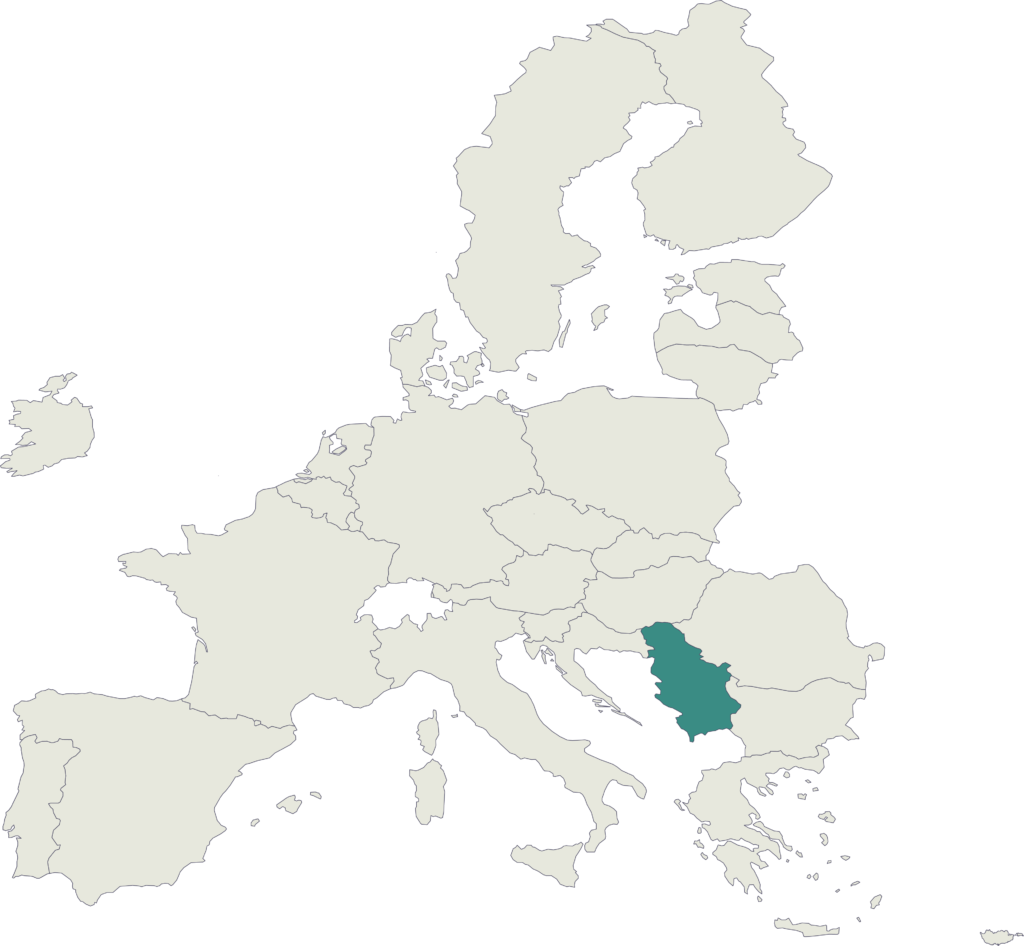
SERBIA & WESTERN BALKAN
A Strategic Overview
The Western Balkans represent a strategically positioned region at the crossroads of EU markets, manufacturing supply chains, and emerging sustainability-driven transformation.
Countries
Serbia, North Macedonia, Albania, Bosnia and Herzegovina, Montenegro, Kosovo*
Population
18 Million
EU Status
Candidates and potential candidates
Geographic position
Direct land connection between EU core markets and Türkiye / Eastern Mediterranean
Trade Orientation
Strong export dependence on EU (Germany, Italy, Austria as key partners)
Serbia is located in Southeastern Europe, at the heart of the Western Balkans, covering an area of 88,499 km² with a population of approximately 6.7 million (excluding Kosovo and Metohija). Its capital, Belgrade, has around 1.7 million residents..
Serbia is a parliamentary republic with Serbian as the official language and the Serbian dinar (RSD) as its national currency.
With a GDP of €75.2 billion in 2023 and GDP per capita of €11,354, Serbia represents a stable and emerging economy in the region, supported by credit ratings of BB+/positive (Fitch) and BBB-/stable (S&P), indicating relative macroeconomic resilience and investor confidence..
Largest economy and manufacturing base in the region
Central logistics and transport hub
Strong integration into EU value chains
Long-standing industrial tradition, especially in textile and apparel, automotive components and processing industries
Strong export dependence on EU (Germany, Italy, Austria as key partners)
Serbia formally started EU accession negotiations on January 21, 2014, positioning itself for deeper political and economic integration with the European Union and enhancing opportunities for regional and international cooperation.
Serbia has a Stabilisation and Association Agreement (SAA) with the European Union, providing duty-free or preferential access for most industrial products to the EU market. The agreement has led to significant alignment of Serbia’s trade rules and standards with those of the EU, facilitating the integration of Serbian industry into European value chains.